Open PositionsLocal sub-THz photons for coherent light-matter interaction
Local sub-THz photons for coherent light-matter interaction
M2 internship and Thesis
The goal of this project is to build a quantum spectrometer in the meV range that opens the road
for the study of quantum coherences in low dimensional systems. It lies at the frontier between microwave and
optics will enrich two fields of research and give access to mesoscopic phenomena such as magnonic excitations
Condensed matter systems are the center of many gamechanging technologies : superconductivity for example has allowed quantum-limited amplifiers for more sensitive detection schemes, and spin excitations, called magnons, hold the promise for energyefficient computation with the emerging field of spintronics. By developing the first on-chip microwave-to-THz frequency converter combined with state-of-the-art topological metamaterials for guiding the signal, this project will provide access to typical coherence times of magnons in nano-resonators made of YIG thin films, and access the dressed magnonic state resulting from light-matter interaction. Ultimately, this platform will allow for the exploration of novel physics such as quantum magnonic [1].
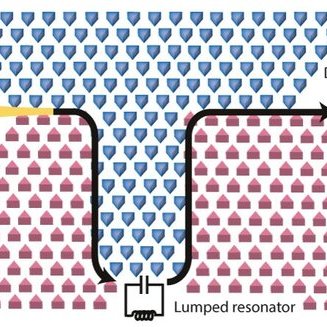
Figure 1 : a) Lumped resonator for the coupling between light and a magnonic excitation
in a YIG thin film. b) Schematic of a THz local sensing platform. On-chip frequency conversion allows for a short distance
over which the THz signal will propagate. A lumped resonator coupled to the system under study is probed using a coherent excitation.
In a thin film geometry the number of spin is very low (N ∼ 10⁵) and the magnons energy is in the meV range, which corresponds to sub-THz frequencies. To provide a local probe on mesoscopic scales (typically 1 μm), the PhD student will simulate, fabricate and characterize lumped superconducting THz resonators (see fig. 1a), that will increase the coupling between the so called ’circuit’ photons and the magnons. In parallel, the student will develop an integrated THz detection platform using the non-linearity induced by a thin superconducting film to realize four-wave parametric frequency conversion [2]. Finally, to convey the signal from the converter to the resonator, a topological metamaterial will be designed. These metamaterials have already been used to strongly attenuate the losses due to radiation [3].
The goal of this PhD is to bring together a frequency converter based on NbN superconducting thin films, and topological waveguides in Silicon to guide THz signals towards a high quality resonator for the detection of magnons in thin films (see fig. 1 b). The applications of such a platform for THz physics goes from fundamental condensed matter physics to state-of-the-art quantum information.
Prerequisite : A strong background in quantum mechanics, condensed matter physics and a taste for simulations and Python coding are recommended.
[1] Y. Tabuchi, S. Ishino, A. Noguchi, T. Ishikawa, R. Yamazaki, K. Usami, and Y. Nakamura, “Quantum magnonics : The magnon meets the superconducting qubit,” Sci. Direct, vol. 17, pp. 729–739, 2016.
[2] M. Pechal and A. H. Safavi-Naeini, “Millimeter-wave interconnects for microwave-frequency quantum machines,” PRA, vol. 96, 2017.
[3] Y. Yang, Y. Yamagami, X. Yu, P. Pitchappa, J. Webber, B. Zhang, M. Fujita, T. Nagatsuma, and R. Singh, “Terahertz topological photonics for on-chip communication,” Nature Photonics, vol. 14, pp. 446–451, 2020.
 ESPCI web site
 CMQED group