Bio-inspired superconducting sensors for sub-THz technologies
Objective : The overall objective is to develop an ultrasensitive, on-chip sub-THz spectrometer that mimics the cochlea’s remarkable ability to decompose complex audio signals. This will be achieved by combining graded metamaterial designs with the nonlinear dynamics of superconductors.
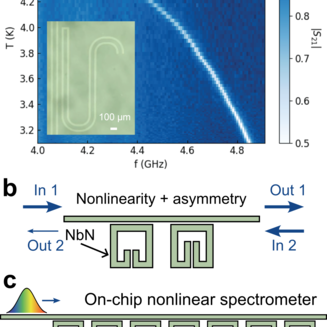
The human cochlea is an extraordinarily sensitive sensor that decomposes sound into spatially separated frequencies across three decades with a dynamic range exceeding 120 dB. At its core, the human ear is based on a collection of sub-wavelength non-linear resonators. In the sub-THz frequency range, the losses become too high to realize efficient detectors, but superconductors exhibit minimal ohmic dissipation and a kinetic inductance that varies quadratically with current [1, 2]. For example, Fig. 1 a shows the dependance in temperature of a CPW resonator frequency due to this kinetic inductance.
The goal of this PhD project is to use this intrinsic nonlinearity to mimic the non-linear amplification occurring in the cochlea, providing tunability and enhanced spectral selectivity. At first, the candidate will characterize the response of a few subwavelength superconducting resonators at 100 GHz. The measurement of the self-Kerr non-linearity will give access to the quadratic dependance on the current I inside the superconducting resonator (see Fig. 1 b). This will give the opportunity to study non-reciprocal behavior in non-linear systems which may have crucial applications in the field of quantum technologies.
Figure 1 : a, NbN resonator measured bolow its critical temperature b, Nonreciprocal transmission within a planar superconducting metamaterial based on the nonlinear inductance of NbN. c, Rainbow trap geometry
The PhD student will then create a rainbow trap experiment in the sub-THz as depicted on Fig. 1 c. This structure introduces a radically new approach to sub-THz spectroscopy, inspired by the acoustic behavior of the human cochlea. Unlike conventional TDS systems relying on bulky optics and timegating, it aims for a single-shot, fully integrated superconducting on-chip spectrometer that directly maps frequencies in space. Its originality stems from three main elements : bio-inspired active graded designs, superconducting metamaterials with minimal dissipation and intrinsic kinetic-inductance nonlinearities, and operation in the underexplored sub-THz regime, promising for molecular and quantum sensing. By exploiting the synergy between biological efficiency with quantum-graded materials, we aim to establish a new class of compact, high-performance spectroscopic sensors.
[1] B. Ho Eom, P. K. Day, H. G. LeDuc, and J. Zmuidzinas, “A wideband, low-noise superconducting amplifier with high dynamic range,” Nature Physics, vol. 8, no. 8, pp. 623–627, 2012.
[2] J. Luomahaara, V. Vesterinen, L. Gr¨onberg, and J. Hassel, “Kinetic inductance magnetometer,” Nature Communications, vol. 5, no. 1, p. 4872, 2014.
 ESPCI web site
 CMQED group